








For the longest time, I have struggled to understand one feature of Mumbai’s dining scene. Nearly 80 years after independence, why does a stratum of the city’s elite still eat bland, boiled, mashed, white-sauce-deluged holdovers from the colonial era? In a city brimming with cheap and tasty eats, how is it possible that people willingly empty their wallets for things like Chicken Cecilia or Shepherd’s Pie? How on earth can Indian palates tolerate the stuff?
Pronoti Datta, the author of a new book on Mumbai’s food history, is, unlike me, impartial enough to not pass judgment on the taste (or lack thereof?) of some Mumbaikars. Instead, she uses the city’s Continental fare to launch a rich and detailed account of Mumbai’s food history. And, beyond those grim redoubts of white sauce concoctions (pardon my continued editorialising), she discovers a galaxy of delicious and beguiling combinations. Shrimp in banana cake. Eggs on top of bananas. Biryani made out of patrel. And Bombay duck everywhere.
Datta joins Past Imperfect to discuss her book, In the Beginning There Was Bombay Duck, and educate us on the cuisines that feed the Maximum City. Datta digs deep into the colonial past, unearthing stories and recipes from dusty books. She also talks extensively with cooks, bakers, restaurant owners, caterers, and food historians. And, most importantly, she savours food across Mumbai’s culinary landscape, triggering a particularly stomach-growling form of FOMO amongst her audience.
In this episode, Datta uses food and restaurants as windows into Mumbai’s complex social and political landscape. With the exception of Irani cafes, the city’s restaurant culture has never been terribly democratic, she notes. Instead, it has been riven by caste-based and socioeconomic divisions.
In days past, Udipi cafes and “Hindu restaurants” catered to Brahmin and upper-caste clientele. Today, the city’s elites segregate themselves in fancy Lower Parel dining spots and outposts of international chains. Perhaps it is no mistake that some of the last bastions of Raj-era Continental fare are the city’s status-conscious clubs. Elsewhere, Maharashtrian snack items like vada pao have been imbued with political meaning. Vada pao has become a potent symbol of nativism despite the fact that almost all of its main ingredients were not native to India before the Portuguese arrived.
The politics of food in Mumbai, therefore, is complex. But the actual food can be startlingly simple and straightforward. Datta notes that Koli cuisine is, by necessity, something that can be quickly cooked, utilising the most recent catches from fishing trawls. Items like vada pao and pao bhaji were probably created for mill workers who needed something simple, cheap, and quick to digest between shifts.
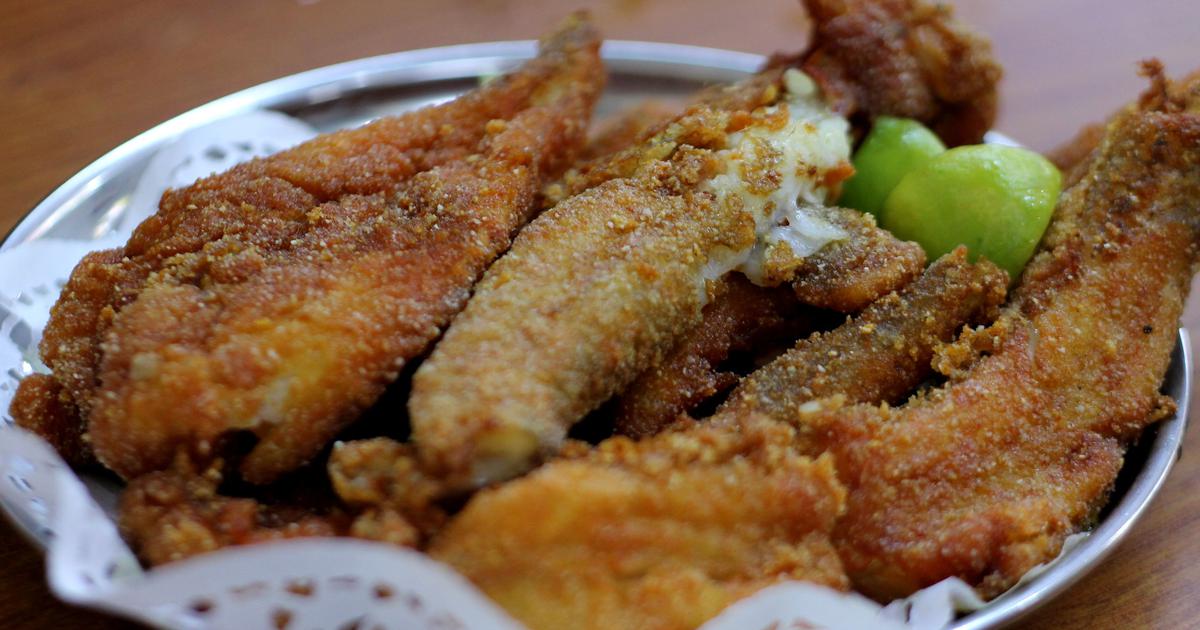
Ready access to seafood explains why one 19th-century British writer described Bombay’s surrounding towns and villages as “fishy, fishier, fishiest.” Communities from the Konkan put seafood in completely unexpected places: for example, mumbra, the Pathare Prabhu banana cake cooked with prawns or Bombay duck.
Above all, Mumbai’s cuisine is adaptable. In Datta’s account, the figure of the Goan baker and chef constantly hovers in the background. Goans, long exposed to European ingredients and methods of cooking, were instrumental in shaping so much of the food we eat today. They staffed some of the city’s first prominent restaurants and labored in the kitchens of rich merchants and industrialists. Along the way, they took certain uninspired and insipid Western dishes and added a heady dose of masala. Perhaps, thanks to them, even today’s Chicken Cecilia is more palatable than its original form.
Through agents like the Goan chef, food in Mumbai became dazzlingly international. Sindhis, those globe-trotting entrepreneurs, found macaroni somewhere in the Mediterranean and indigenised it as macroli. While trading in China, Konkani Muslims might have observed local chefs cracking raw eggs on top of rice and noodles, thus explaining the origins of saravle. Even more “authentic” items might have an international backstory. Could itinerant Gujaratis have perfected their infinite varieties of farsan precisely because it traveled so well over long distances?
Mumbai has its share of well-known culinary landmarks such as its Irani cafes and Ramzan dining spots in Bhendi Bazaar. Fierce altercations, no doubt, could break out on the subject of which place in and around Chowpatty serves the tastiest chaat. But the strength of Datta’s book is that it goes beyond this familiar Mumbai eating-scape and investigates those cuisines which are sorely underrepresented.
She meets with Bene Israelis and samples their answer to hamantaschen, eaten on the Jewish holiday of Purim (this turns out to be delicious puran poli). Turning to the East Indian community, she goes boldly beyond bottle masala and surveys their litany of savory dishes and sweets. Aside from inducing hunger pangs, all of this paints a vibrant tapestry of Mumbai’s diversity.
Mumbai emerges as a culinary laboratory four centuries in the making, a place where food serves as a barometer for social and cultural change and continuity. Reading Datta’s book, it becomes obvious that one of the best ways to understand Mumbaikars is through their stomachs. Even if some of those Mumbaikars continue to defy all common sense by ordering things slathered in white sauce.
Dinyar Patel is an associate professor of history at the SP Jain Institute of Management and Research in Mumbai. His award-winning biography of Dadabhai Naoroji, Naoroji: Pioneer of Indian Nationalism, was published by Harvard University Press in May 2020.
Past Imperfect is sponsored and produced by the Centre for Wisdom and Leadership at the SP Jain Institute of Management and Research.
